Examining the Jeremy Lin Phenomenon Through a Critical Lens
Erica Chito Childs / Hunter College and CUNY Graduate Center


Amidst media reports about America’s post-racial state, NBA player Jeremy Lin seemingly appeared out of nowhere to bring the struggling New York Knicks a slew of victories. The success of Lin, a Taiwanese-American, has sparked a media sensation, or in other words, a Linsanity. The media coverage and public debate over Lin may be referenced as further evidence of post-racial America, yet it is better understood by looking at the historical context of race relations, constructions of racial stereotypes and systemic racism.
On one hand Jeremy Lin has captured America’s attention because his story affirms the American Dream. As Sports Illustrated writes, Lin succeeded “against all odds†with hard work, determination and perseverance.
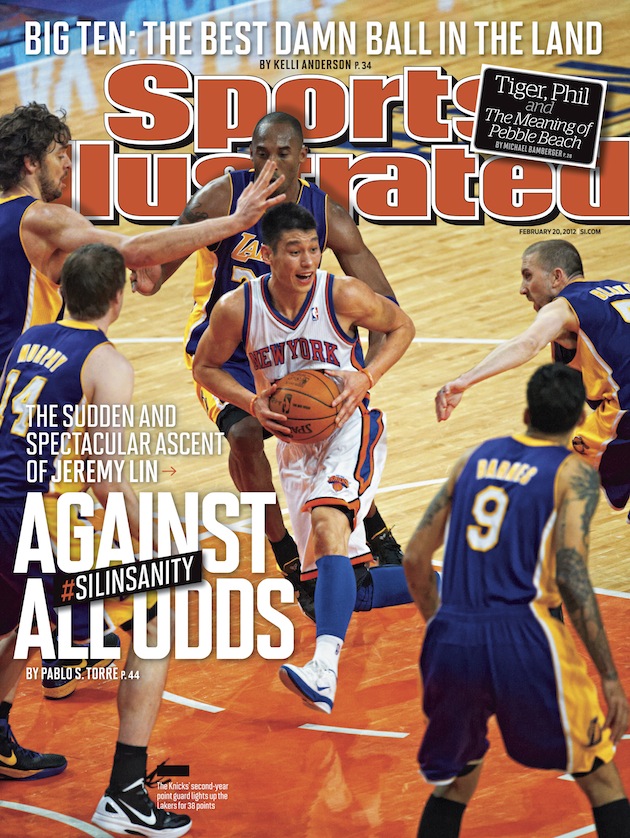
The media touted Lin as the quintessential underdog, deserving of this attention even more because of his modesty and morality. There were inevitable comparisons to the NFL quarterback Tim Tebow, as Lin was similarly described as a man of great faith. The characterization of Lin not only fit into the ideology of the American Dream, but also the model minority myth where Asian Americans have been constructed as a successful racial minority group due to their intelligence, work ethic and demeanor. While seemingly positive, the model minority myth simultaneously marginalizes Asian Americans, creates interracial tensions between non-whites, and maintains white privilege (which will discussed more in a later section).
Lin’s Story in Historical Context
While the Lin phenomenon was presented as something new, Lin’s story follows a distinct pattern well documented through historical conditions and contemporary practices. The historical realities, the way history is retold, as well as who and how contemporary stories are told is part of what Gramsci described as the way those in power “establish a certain ‘definition of reality’ which is accepted by those over whom hegemony is exercised.â€1 While slavery and legalized segregation has disappeared, these representations and ideologies of the intersections of race and gender are an integral part of contemporary racial oppression or what Joe Feagin terms systemic racism, “the racist framing, racist ideology, stereotyped attitudes, racist emotions, discriminatory habits and actions and extensive racist institutions developed over centuries by whites†which permeates all of society.2
Scholars such as Ronald Takaki and Gina Marchetti have traced the idea of Asians as dangerous to the West’s fear of the “East,†as early as medieval Europe’s fear of Genghis Khan. Immigration practices and laws were intricately tied to these constructions of Asian men and women. Since Asian immigration was largely used as a tool for cheap labor recruitment of Asian males, who were viewed as “temporary individual units of labor rather than as members of family groups,†the immigration of Asian women was restricted.3 These restrictions also served to desexualize Asian men, as they were denied the ability to have families, constructed as asexual and non-masculine, and the Asian American population was minimized.4
While being characterized as asexual and feminine, the legal exclusion of Asians through various immigration acts affected Asian American communities until the eventual abolishment of “national origins†as a basis for quotas with immigration in 1965. Asian men were unable to start families because immigration laws banned the immigration of most Asian women and anti-miscegenation laws prohibited men of color from marrying white women. Accompanying the structural factors preventing Asian men from marrying, cultural narratives characterized Asian men as hypo-masculine and sexually deviant, eunuchs and rapists.
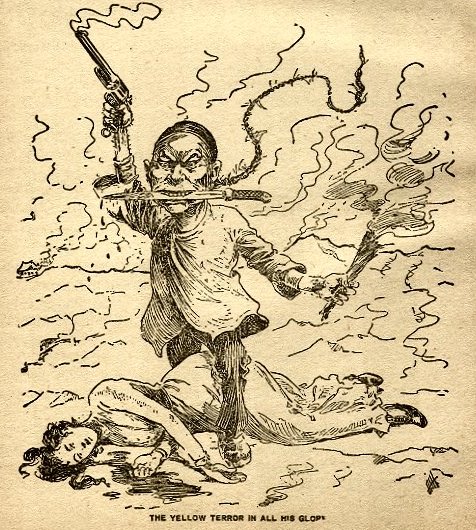
Asians were also constructed as the “Yellow Peril,†posing a threat from military invasion, business monopolization through foreign trade, competition for labor positions, and miscegenation with whites.
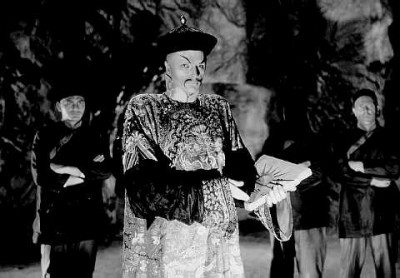
Asian men were depicted as de-masculinized and desexualized, such as the character of Charlie Chan or the evil enemy of the white man, like Dr. Fu Manchu who wanted to take over the West, yet was still depicted as feminine, wearing a long dress, long fingernails, and homosexual desires.((See Chin and Chan1972; Espiritu 2000; Hoppenstand 1983; Wang 1988)) Traditionally Asian men have been depicted as the opposite of desirable masculinity. Still today, Asian American men are rarely cast as lead actors in mainstream American films, and even rarer, as romantic leads.
The Lin Connection
Connecting this to Jeremy Lin’s supposedly sudden rise to NBA fame, Lin’s success was far from overnight. In contrast, these very stereotypes of Asian-American men had been in play throughout Lin’s career. Despite a stellar high school basketball career at Palo Alto High School where he was named first-team All-State and Northern California Division II Player of the Year, he received no athletic scholarships or offers to play college basketball. With an impressive grade point average, instead he went to Harvard where he was guaranteed a place on the basketball team. At Harvard, he demonstrated his basketball skills and set Ivy League records in points scored and other areas, yet he went undrafted. Eventually he went to the Golden State Warriors before ending up on the New York Knicks bench. Arguably, Lin was invisible because of these racial stereotypes of Asian-American men as weak and lacking athletic prowess.
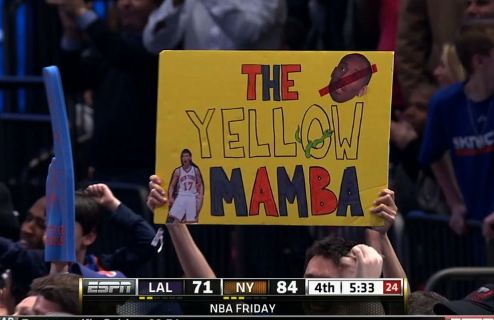
Despite the fanfare surrounding Lin, his newfound success has also spurned a slew of racial stereotypes. On Facebook and countless blogs, these type of images are making the rounds.
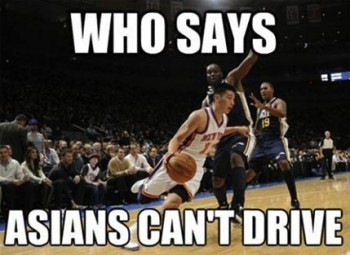
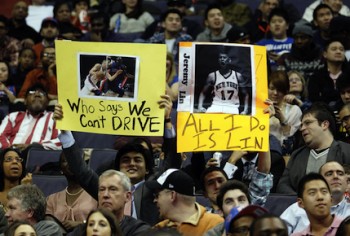
On Friday February 17, ESPN posted a commentary on the New York Knicks loss, headlining the story with “Chink in the Armor.†ESPN quickly removed it after less than an hour and offered an apology, yet the tenacity of racial stereotypes was clear.
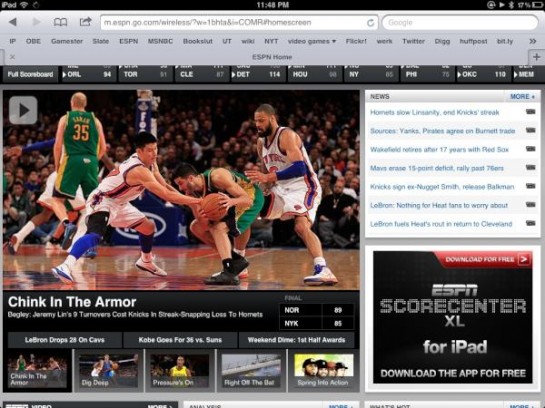
On the blacksportsonline website, the commentary accompanying this ESPN screenshot read,
My messages to those people, stop being so sensitive and enjoy the General Lin ride. Sometimes you have to understand the intent, before you get your panties in a bunch and the intent was to celebrate Lin’s skills, not offend anyone.
This brought to light a point raised earlier about how racism and racial stereotypes pit racial groups against each other. Sports commentators such as former NBA player Steve Smith expressed these same sentiments, arguing that charging racism over the use of the phrase “chink in the armor†was not justified, or at least not the same as someone using a racial slur towards African Americans.
[youtube]http://www.youtube.com/watch?v=lEmjGMWnRcI[/youtube]
Boxing champion Floyd Mayweather responded to Jeremy Lin with the following tweet.
‎â€

Given the history of systemic racism where Asian American men have been characterized as intellectually superior yet de-masculinized while African American men have been characterized as hyper-masculine yet intellectually inferior, these reactions are not surprising. Whites remain the norm by which others are judged. “Whiteness represents the cultural norm the implicit standard from which blackness deviates,â€5 and Latinos, Asians, all non-white Others fall somewhere in between. In particular white privilege and dominance is maintained against the beliefs about men of color as asexual (particularly Asian men), or sexual savages. Saturday Night Live offered an insightful yet controversial response, highlighting the stereotypical and racist responses to Jeremy Lin in the media.
[youtube]http://www.youtube.com/watch?v=nRvKzlOVFNM[/youtube]
Contemporary representations of racial Others are based on the ideologies that were created to justify historical conditions and reflect contemporary debates over racial identity, racial locations, nationalism, and citizenship. The problem lies not in the images but in the social relations that underlie, inform, and exist outside which contribute to the subjugation and degradation of certain races and ethnicities. As we see from looking at historical and contemporary practices, racial representations have been used to privilege, protect and illustrate the power of whiteness, particularly for white men. The connection between the treatment of racial and ethnic groups in society and their treatment in the media reveals patterns, which we can use as a framework for understanding contemporary racial attitudes. Rather than point to a post-racial America, Jeremy Lin’s rise to NBA super-stardom has highlighted the lingering racial stereotypes and racism. While garnering widespread support, the media and public reaction to Lin has also been plagued by continual racial references and racist comments. Jeremy Lin fascinates the American public because his story embodies the racial narratives that have dominated such as the model minority myth and the American Dream ideology, yet it also stands to challenge racialized and gendered stereotypes.
Image Credits:
1. Goldenrankings.com
2. CBS News
3. Sports Illustrated
4. Wikipedia Commons
5. Black Sports Online
6. You Offend Me You Offend My Family
7. intheweeds2-willyce.blogspot.com
8. Laker Life
9. Jim Romenesko
10. twitter.com/FloydMayweather
- Page 173 in Chantal Mouffe, “Hegemony and the Integral State in Gramsci: Towards a New Concept of Politics, page 167-187, in (Eds) George Bridges and Rosalind Brunt, Silver Linings: Some Strategies for the Eighties (London: Lawrence and Wishart Ltd). [↩]
- Feagin 2006: :xii [↩]
- See Espiritu 2000:9-10 [↩]
- See Espiritu 2000; Goellnicht 1992; Lyman 1968 [↩]
- Hunt 2005:4 [↩]
Thank you for a fine article on the media portrayal of Jeremy Lin. It does make me wonder what it is about cultural conceptions of basketball that contributes to how Lin is racialized. I recall Asian American tennis player Michael Chang having a very successful career in his sport, winning the French Open in 1989 and eventually ranking number 2 in the world. Yet I don’t recall any undue emphasis on Chang’s ethnicity. This shows that an Asian American can have a successful sporting career without raising too many eyebrows. I also recall that Lin, when interviewed about his own experiences with racism, named multiple occasions in which he showed up for a college game and told by some helpful white person that he had the wrong venue – this was a basketball game, not a volleyball game. What separates tennis and volleyball from basketball in the public consciousness, I would argue, is how the two former sports are feminized. For evidence of this, note that they are perhaps the only two sports in which males and females receive roughly equal television coverage. By contrast, compare the coverage given to the NBA with the WNBA. The feminization of tennis and volleyball connects with the feminization of Asian Americans. Basketball, on the other hand, is a masculine, red-blooded sport.
Though I hope I don’t sound too harsh, the media coverage of Jeremy Lin has always seemed to me to have the mentality of a freak show. The constant harping on Lin’s race seems designed to emphasize the incongruity between Lin’s prowess for the manly sport of basketball and his ethnic heritage. Even the incessant punning on Lin’s name seems contrived to assure the viewer that no other American basketball player could have a name like “Lin.†Like a bearded lady, the supposed mismatch between Lin’s masculine athletic skills and feminine racial identity is set up to be gawked at by an amused public.
The case of Jeremy Lin also says a great deal about what it means to be a “model minority†in America, especially when Asian Americans are compared to African Americans. As the SNL clip deftly illustrates, the racial stereotyping directed at Lin wouldn’t fly when directed at African Americans. In the United States, explicit slurs and stereotypes aimed at African Americans are suppressed because they would draw attention to the institutional racism that still affects all African Americans. For Asian Americans, who have supposedly succeeded within the framework of American institutions, slurs and stereotypes of all kinds are permitted so long as “the intent [is] to celebrate†rather than insult. Model minority status, in addition to being problematic in itself, also acts as permission to stereotype (or to ignore) because the groups it is conferred upon supposedly lack the grounds of victimhood on which to object. Thus, I believe that Jeremy Lin gives us insight into the sources of the problems of Asian American representation (or lack thereof) on television.
The Jeremy Lin phenomenon is certainly rife with problematic displays of Asian-American representation. As you have discussed, sports news institutions like ESPN and Sports Illustrated have demonstrated the media’s tendency to perpetuate stereotypes that ultimately reinforce white hegemony. Tim Tebow was certainly not the first successful football player to vocally and adamantly express his faith in God, but ever in pursuit of “The Story,†sports media jumped at the chance to declare “Tebowmania.†While his Disneyesque come-from-behind victories undoubtedly contributed to his stratospheric rise to fame, the phenomenon cannot be separated from his resounding appeal as a sort of Great White Hope for Middle America, where football fanaticism reigns supreme.
One especially fascinating aspect of “Linsanity†is the story that isn’t being covered, that of Sacramento Kings point guard Isaiah Thomas. Following a similar trajectory as Lin, he was a college star with the Washington Huskies before getting picked last in the 2011 NBA Draft. Like Lin, he quietly made the transition from relatively unseen and unheard of bench player to dominant NBA point guard, a staple of his team’s offense. Yet no fanfare, no ESPN Top Stories, no Sports Illustrated covers. His stats are comparable, but his media attention is far from it. Why? There are several possible explanations. As a sports media hotspot, Sacramento pales in comparison to the high profile New York Knicks, recently making a splash by acquiring All-Stars Carmelo Anthony and Amare Stoudemire.
Yet what it ultimately comes down to, in my opinion, is race. Forget the fact that Thomas was told he was too small to make it as an NBA point guard. Forget his months wasting away on the bench before being given an opportunity to shine and hitting it out of the park. It seems that his underdog appeal is undercut by the fact that he is black. What, after all, is so unusual and newsworthy about a talented black NBA point guard? When picking and choosing “phenomena†in the world of professional sports, buzz words like “Asian†and “Harvard†certainly carry more weight than “undersized†and “black.†The story is similar, the stats are comparable, yet one player sparks “Linsanity†and the other is barely known at all. It appears that our supposedly “color-blind†society still decides what is news and what is not with race firmly in mind, inevitably leading to racial stereotyping and marginalization in the service of maintaining existing hierarchies.
Thank you for an insightful post. I wanted to add that the stereotypical representations of Asian and Asian-American men within American media are obviously not limited to sports but are kept alive within television.
The dancer and actor Harry Shum Jr, from the tv show Glee, spent a whole season playing a character called “Other Asian.†Due in part to Shum’s successes in other media (Legion of Extraordinary Dancers [http://www.hulu.com/watch/162538/the-lxd-elliots-shoes] and So You Think You Can Dance [http://www.youtube.com/watch?v=rrxOBxlQmho&feature=player_embedded]), his character was given a name, Mike Chang, but for the second season he was still most often relegated to dancing in the background behind his fellow stars, adding to the strength of their performances instead of starring in his own. For example, in the episode The Substitute he dances in a dream sequence with Will Shuester, played by Matthew Morrison who is also an accomplished dancer. The character Mike Chang can’t really be described as asexual, as he is allowed to have a relationship with the only other Asian lead, Tina, but his masculinity on the show is suppressed. He plays quietly on the football team but, unlike the white male characters on the show, it is never brought up as a storyline except when Chang supports Artie, who is wheelchair-bound, in his attempt to join the team. Finally promoted from guest star to series regular in the third season, Chang was given a storyline in the episode “Asian F†and his first solo, “Cool†from West Side Story.
First of all, I am so glad that commenter Jeanne Jo (above) mentioned Glee – if anyone thinks we’re living in Post-Racial America, they need only watch a single episode of that show to understand that Post-Racial America is a myth. The depictions of Asian Americans (they’re either silent or stuttering, at least in the first season) and African Americans (who are only present on the football team or trying to claw their way into the spotlight because that’s what a “diva†does) are so disgustingly stereotyped that one must question how a show like that is even on the air.
Second, this article fascinated me (as all the media buzz surrounding Jeremy Lin has done) because I was in his class at Harvard. I didn’t actually know him, and the buzz surrounding him was no where near as great; he was just another guy who happened to be on the basketball team and also happened to be very involved in the Asian American community. All this emphasis on his Asian American-ness is something that I think is sadly not unexpected from today’s media. Commenter Brett Siegel (second above) makes a solid point with his description of Isaiah Thomas (the black point guard for the Sacramento Kings who went through a struggle similar to Jeremy’s but was ultimately largely ignored by the media). Jeremy Lin’s rise to fame is interesting to Americans (and the American media) because he breaks Asian American stereotypes. I think this is a scary thing for white America (as the article says – white fear of Asians can be traced all the way back to “medieval Europe’s fear of Genghis Khan), which is why there have been such offensive things said about him by white males in the media. I also agree with commenter Robert Ashmore (top) that basketball has been racialized as a black man’s game. Americans are, therefore, trying to wrap their heads around the mere possibility of an Asian American man – who, as the article says, is the stereotyped opposite of the black man – being able to play the game well.
It’s pretty frightening, actually, how the media can shape Americans’ perceptions of race and culture. Certain phrases that the media has made it all right to say on television about Jeremy, as the article describes, have ended up on fans’ posters, blogs, and bodies. But it’s a circular pattern; in today’s America, the “media†is not just the TV screen, but also the countless outlets that the Internet provides for communication. The Linsanity memes, for example, that are all over the web have been reported on by television news sources. Tweets about Jeremy have ended up in the New York Times. The level of anonymity that the Internet provides also means that more offensive thoughts can bubble to the surface without fear of accountability, and our culture-defining media takes a negative turn.
Hopefully, Jeremy Lin’s story will mean that there are more fully-balanced portrayals of Asian Americans in the media. Hopefully, everyday white and black Americans will begin to see Asian Americans are more than the model minority stereotype. If these hopes were fulfilled, we would truly be living in a Post-Racial America. But I think we’ve still got a long way to go before we can officially say this about our country and our culture.
Being an Asian guy, I figured I’d weigh in with some personal experience – not necessarily as an authority, but more as a particular viewpoint.
First of all, amidst the inevitable backlash against Jeremy Lin’s media overexposure (ranging from sceptical articles from sport writers to cries of “overrated” during the Knick’s away games) some of the most interesting viewpoints I’ve heard are from other Asian Americans. A friend of mine found the whole situation annoying, asking “Why all the hype now? Where was everyone when Lin was warming the bench at Golden State?” This was shortly after Floyd Mayweather’s anti-Lin tweet (“All the hype is because he’s Asian.”) Now, while I didn’t appreciate the sentiment behind Mayweather’s tweet, I found myself agreeing with the boxer. The interesting thing about this story is because Lin is Asian and he’s good basketball player.
There are other interesting aspects the story, of course – his Harvard days, his years of not receiving recognition for stellar play, his storybook breakout performance off the Knick’s bench. All of these elements make for good narrative, but it’s the racial aspect that really kicks this one up a notch for journalists, for the viewing public, and for Asian Americans. As with the other commenters on this article, I was pretty fascinated by Brett Siegel’s account of Isiah Thomas’s early career, and it provides an interesting context for Jeremy Lin’s story.
I also feel that the media narrative for Asians and Asian Americans has begun to change in Jeremy Lin’s coverage. Asian scholars, activists, and artists have long noted the extent to which Asian Americans as a community have had to tolerate behavior and attitudes that wouldn’t be considered against other racial groups, and ensuing protests by Asian American media and community groups have often resulted in non-apologies or no response at all.
However, during this past Linsanity media phase, what struck me was that journalists were finally starting to hold their peers accountable for any perceived racism, something which I had not seen before. And I did get a big kick out of the SNL skit referenced in the article. The thesis of the skit is one that has long been echoed in the Asian American community, and SNL’s presentation of it was probably the highest profile exploration of that idea.
The ESPN firings for the “Chink in the Armor” headlines were surprising to me as well, in that I was surprised that ESPN would think the issue important enough to actually fire someone over it, something I never would have imagined years ago. As an aside on that topic – an ESPN radio affiliate host was reprimanded (though not fired) for using the same phrase on the air, around the time of the headline. I personally think it’s believable that the host might not have had any racial connotations as it was live radio and a lot of what’s said on live radio is off the cuff. However, if there was anything I learned from my brief days in school journalism, it’s that quite a bit of thought goes into a printed headline. I can’t imagine the writer/editor didn’t know what they was doing when they put it out. Whether they should have been fired over the issue is up for debate, but I personally think that they were fully aware of what they were doing.
Despite the fact that Floyd Mayweather has taken a few more shots to the head than one should in a lifetime, I understand the root of what he is trying to say. As his comments pertain to the hype surrounding Jeremy Lin, he has a point in the sense that other players (both black and white) are doing unbelievable things. Minnesota Timberwolves Forward Kevin Love, a white player, just had a 50-point, 20 rebound game (something that hasn’t been done in over 30 years.) Not to say that I completely agree with what Mayweather is saying, because his comments feel very bitter and are factually and circumstantially incorrect. If another player, not of Asian descent, had done what Jeremy Lin was doing, I guarantee it would’ve been heard about just the same had he been any other race.
First of all, what are the reasons this Jeremy Lin phenomenon is so impactful? He’s the first Asian American player in the NBA. He’s a Harvard graduate. He somehow was able to slip through the cracks of scouts — in a league where scouts are known to have an understanding for who the best prospects will be around the age of 14. He was cut from various teams while in the NBA. He also has a strong faith. There is no one else to compare to Jeremy Lin. It’s a completely unique story, which is why its had such an impact. Once again, It’s a unique avenue to success that would have captured the hearts of fans had he been any other race.
In contrast to Robert Ashmore’s comment above about the NBA being a black man’s game, there was a time when the NBA was actually a white man’s game (only 60 years ago.) Los Angeles Lakers great Jerry West is the logo of the NBA! African American players were introduced into the NBA around 1950. However, players like Bill Russell and Wilt Chamberlain transformed the public’s perception in regards to African Americans playing professional basketball. Were those stories any less of an impact than Lin’s is today? Those stories occurred during a time when this country was as divided as it’s ever been. Therefore, I would argue that those were even bigger stories. The only reason Lin’s story seems bigger is because of the way we peddle information around via social media. Also, the NBA is an entity that is more popular today in culture than it has ever been in history.
The obvious problem that has occurred as a result of all this is the direct (in some cases indirect) racist comments, posters, blogs and articles. I, for one, am surprised that so many people are surprised that people still make racist comments. We honestly have not come as far as people want to believe in this country as it pertains to racism. Racism today is just much better hidden. It’s illegal to segregate schools, so we hide the fact that many neighborhood schools are segregated by saying it’s a “predominantly _____________ school.†I grew up in Los Angeles and if you ask anyone else that did, or knows the area well, ask them what predominantly exists at Beverly Hills high, East Los Angeles high, or Verbum Dei high is Watts. Yes, we have made progress as a whole and everyone seems to be more tolerant of everyone else overall. However it can’t be escaped that we still have racism deeply rooted in our everyday lives.
We just happen to be talking about a race that is seldom at the forefront in regards to this topic, so people are having more “slip-ups†than usual. The good thing is that everyone is talking about this. Light is being shed on a group of people that have experienced as much racism as every other culture. As a result people will learn to be more sensitive and think before they speak in the future. Unfortunately, these asinine comments and postings have to be made, so that others can jump down their throats to help them understand the severity of what is being said.
It is really excitted to have such a knowledge its because of your sharing.all the best for your new creation of blogging. hotel frankfurt offers you comfort and enjoyable stay at frankfurt.http://www.hotelklein.de/ visit for more information
Anyone who frequently watches NBA games is probably overly familiar with the ubiquitous “NBA Cares†commercials. Generally, these ads are focused on the community efforts of players throughout the league, especially its stars. Players are shown working with children, serving food at homeless shelters, promoting literacy, etc. Importantly, the commercials are not meant to promote the noble causes in the background, but rather the act of NBA players participating in charitable efforts.
In rather obvious ways, these commercials are racially motivated. That is to say, it appears that the main goal of ads is to demonstrate that its stars, who are primarily black, are good people — kind, modest, non-threatening and very much interested in helping their communities. That the commercials would be set up this way is not necessarily surprising. The first thing to mention here is that the NBA is perhaps the only major American sports league where the racial makeup audience does not closely match the racial makeup of the league’s players, as ~75% of NBA players are black, but ~70% of fans are white. Thus, one of the constant talking points involving the league revolves around a worry that the black players will eventually alienate the white fanbase. What also must be mentioned is the history of the league. As Brandon already mentioned above, the league made a transition from being predominantly white to predominantly black several decades ago and there was tension as this transition was made. Tensions, though, have not faded and have remained firmly in place in the decades that followed this transition, including in recent years. In the 1990s, for example, it was commonplace to hear TV hosts and radio commentators refer to the league’s black stars, such as Stephon Marbury and Allen Iverson, as “thugs.†This sort of labeling continues today, if in less obvious ways. For instance, after NBA rookie John Wall performed a short dance while being introduced at his first game back in 2010, ESPN host Colin Cowherd described Wall as unintelligent and dismissively compared him to players like Iverson. As the popular sports blog Deadspin commented, Cowherd’s rant was “basically three minutes of a man trying very hard not to say the n-word.†Race has also been a part of conversations surrounding recent events like LeBron James’s decision to move to the Miami Heat and the 2011 lockout negotiations.
One recent historical moment worth highlighting at further length is the 2004 Pacers-Pistons brawl, which involved not just fighting between players, but also players venturing into the stands and physically attacking fans. In the months after, a big topic of discussion around the sports world was whether the incident would reinforce the “thug†image of black players and negatively affect how white audience members might view the league. Apparently reacting to this fear, the NBA instituted a dress code the next season, requiring players to wear business attire to games. This move sparked even further discussion, with numerous players and league observers describing the move as racist because, in the words of The Guardian, such a move seemed to be an effort to ban the “hip-hop look adopted by many of the NBA’s young black players.†In other words, the purpose was “to make a predominantly black league more palatable to a predominantly white audience.â€
Throughout all of this, the league itself has mostly preferred to avoid explicitly mentioning race. Rather, it is has preferred to indirectly get involved in racial controversies, whether by producing content like the “NBA Cares†commercials or by instituting policies like the dress code. This is why one of the most recent “NBA Cares†commercials is so interesting. In this ad, several NBA players discuss how the game of basketball is not divided by race or creed and that the NBA’s appeal crosses racial lines. Importantly, these words are spoken by players of different races. For example, the middle section of the ad is presented by Kevin Love, who has already been mentioned in this thread and is perhaps the league’s most prominent white player outside of Steve Nash and Dirk Nowitzki. Furthermore, as the players talk, a number of pictures are shown on the screen — all of them including players of different races interacting, mostly through shared moments of laughter. The image that seems to be given the most prominence, though, is Jeremy Lin talking with one of the league’s black stars, Paul Pierce. Although the ad is fairly subdued, it is still notable. As far as I know, it is one of the first NBA promotional effort that explicitly discusses race.
The timing of the ad and the prominent inclusion of an image of Lin suggests that it was the racial controversy surrounding Lin that has finally moved the NBA to temporarily shift the “NBA Cares†campaign from backgrounding race to foregrounding it. We are left to wonder, then, what this means. As discussed above, the buzz surrounding Lin was quite frequently racist. Should the NBA, then, be saluted for trying to preach racial harmony? Or, does the appearance of this ad just further trouble the way the league treats its minority players — that is, as potential problems that need to be carefully sold to its fanbase, thus reinforcing racist discourses that often surround the league? Given the league’s history, it is probably appropriate to be skeptical. More than anything, the ad seems to be another problematic attempt to assure the audience that the NBA is a league that embodies “America’s post-racial state.†It seems worthwhile to quickly mention alternatives so that we can wonder what other options the NBA could have pursued if it wanted to discuss race in a more productive fashion. For example, we could look to the campaigns supported by European soccer leagues meant to deal with the massive problem of racism in European soccer, like Kick it Out and Show Racism the Red Card. These organizations have won some praise for their work, including commercials that feature several soccer stars explicitly decrying racism. The NBA might consider something similar — or really anything that shows it cares. As The Root commented a few months ago — just ahead of the Jeremy Lin buzz — “The NBA cannot simply pretend that race doesn’t matter because we’d prefer that it didn’t. Moving forward, the league should operate in a way that is conscious of this power dynamic and show that while racism may seep into the institution, the people in charge are committed to combating its impact.â€
It is interesting how people conveniently relate to Jeremy Lin. Taiwanese finds Jeremy Lin the pride of the nation. Asians get vicarious satisfaction from Lin as he represents Asian race. Other ethnic minorities also embrace Lin, who breaks racial stereotype and norm. Christians also welcome the way in which Lin represents Christianity: humble lifestyle and morality. Accordingly, Linsanity or the Jeremy Lin phenomena carries the multi-faceted meanings. That being said, I want to add national and religious perspective to the in depth examination of racial representation of Jeremy Lin.
Chinese media had a number of interviews with Jeremy Lin. Although he is a Taiwanese American, he is considered Chinese to Chinese media. While Chinese media emphasize Lin’s national origin and ethnicity, Chinese government does not allow Lin’s religion to affect the Chinese. In one of the interview that Lin did with Chinese media, he briefly talked about his belief, identifying God and Christianity as his reason for success. A Chinese news channel showed the original clip of the interview, yet, changed the message by manipulating the subtitle. Since Lin spoke in English, the Chinese media had to provide subtitles. While doing so, the Chinese media did not translate the Lin’s conviction for Christianity. I don’t remember exactly but if I remember correctly, the Chinese media entirely ignored the discussion of religion. This anecdote aptly exemplifies the multilayered discourse that the Jeremy Lin phenomenon embodies. What is more interesting is the fact that the Chinese media would regard Lin as a Chinese. It would be understandable to consider Lin Chinese—though he is not—if he is from Taiwan. But he grew up in America and is accustomed to American culture and language. The connection between Lin and China, if at all, is tenuous. I doubt China gladly identifies other Taiwanese Americans as Chinese. National identity is conveniently constructed and manipulated. Many scholars have already asked the same question, but I can’t resist but to do it one more time: where do we draw the borderline of national identity?
Lin and Tim Tebow have brought another perspective to the mainstream media, that is, religion (Christianity). More often than not, American media attempts to go against certain religious practice and makes provocative remarks on believers. Because of unending dispute between Creationism and Evolutionism, religion is invariably a hot topic. Bill Maher, for instance, never stops denouncing people who follow certain religious practices (mainly Christianity as far as I know). By watching such program, the audience gets the impression that going against religion is cool and logical. I don’t mean to argue whether Christianity is true or not. I just want to acknowledge the general atmosphere that media often creates, that is, religion is not cool and is old-fashioned. Lin and Tebow have appeared under such ambience and made “uncool (religion)†looks “cool.†One can argue that Lin and Tebow have brought new viewers (religious people who are generally not fond of television) to television.
I could not agree more with this article and with the comments that were posted. We are still very far from even approaching a post-racial America and I am still hesitant to state if post-racial America will even exist. America was constructed and modernized on racism and it is still so painfully evident today. As an Asian-American, I am proud of the media hype surrounding Jeremy Lin because it has caused American society to look at Asian-Americans in a different light. I have personally heard from several Asian-American guys that people now take them seriously if they happen to play basketball with strangers. Unfortunately, I have to admit that Mayweather is completely right. The media hype is precisely because Lin is Asian. As the article mentioned, there is a sense of “otherness” even if the media surrounding Lin is supposed to be positive. Media is so captivated by Lin because he is an “other” who managed to rise to the top. And Linsanity only created more distinction between “Asian” and “Americans.” When the media buzzed around Lin, we began to see more Asians asserting themselves online through memes such as the ones posted and other Internet activity. However, this only encourages the sense of “other” because it highlights the differences between representations of Asians and that of whites. Lin may have brought Asians into the spotlight, but that’s all we will ever be. Asians. “Others”.
I do agree with the fact that the Linsanity came as result of Asian-Americans having a more dominant representation in the NBA> As a consequence, sadly, Asian stereotypes have increased in order to feed the craze. The ridiculous thing about this whole Jeremy Lin mania, however, is that not only are non-Asian further racial stereotypes, but also Asians themselves have embraced them as their own. Thus, the Asian community is not doing itself much of a favor by embracing such derogatory terms and types. And since the Asians themselves embrace it, the non-Asians feel it to be ok to do the same. So much for a post-racist America.
This is a interesting article because of the fact that Jeremy Lin’s NBA fame has been linked to racial stereotypes and racism. Thousands of comments such as “Who says Asains can’t drive” have been made, even ESPN has posted an article with the title “Chink in the Armor.” All of these are extremely racist, and yet the people who exclaim these slurs explain that they are only praising him and not attempting to offend anyone. I thought this was an interesting way of putting it. The fact that a racist comment can serve as a compliment for some people. As the author explains, “While slavery and legalized segregation has disappeared, these representations and ideologies of the intersections of race and gender are an integral part of contemporary racial oppression.” This is true, that although we have done away with slavery and other extreme forms of racism, we still have many racist individuals. Many people even speculate that Lin was noticed as a super star int he NBA because of the fact that Asian -American men “are weak and lacking athletic prowess.” To see an Asian-American man perform such athletic skills started the whole Linsanity phenomena.
UPDATE 1-Syria army destroys houses in “collective punishmentâ€
Syrian army bulldozers razed houses in western Damascus on Monday, pursuing what activists called the first campaign of Air Jordan 2012 collective punishment targeting people’s property in areas of the capital hostile to President Bashar al-Assad.
In northern Syria, 18 bodies were Nike Air Max Wavy found in the rubble of a house bombed by a Syrian warplane in the rebel-held town of al-Bab and 13 more are missing, an opposition watchdog group said.
Bulldozers backed by combat troops Adidas Crazy 8 Shoes demolished buildings in the poor Tawahin district, near the Damascus-Beirut highway, activists and residents said.
“They started three hours ago. The Nike Air Yeezy Shoes bulldozers are bringing down shops and houses. The inhabitants are in the streets,†said a woman who lives in a high-rise building overlooking the area.
Syrian authorities restrict independent AdiZero Crazy Light media access, making it hard to verify accounts of the conflict from both sides.
Troops forced residents to erase Cheap Lebron 8 anti-Assad graffiti and write slogans glorifying the president instead, activists said.
“This is an unprovoked act of collective punishment. The rebels had left, there are no longer even demonstrations in Nike Lebron 6 Shoes the area,†said Mouaz al-Shami, a campaigner collecting video documentation of the demolitions.
“The regime can’t stop itself from repeating the brutality of the 1980s,†he said, alluding to mass killings and Cheap Lebron 5 wholesale destruction in the city of Hama in 1982 under Assad’s father, the late Hafez al-Assad, who ruled Syria for 30 years.
Hama had been a centre of a Nike Lebron 4 Shoes Sunni Muslim revolt in the 80s. Sunnis have also been the backbone of the uprising Bashar al-Assad is now facing.
The Assad family and most members AdiZero Rose Dominate of the ruling elite belong to the minority Alawite sect, an offshoot of Shi’ite Islam.
“The regime has not changed. AdiZero Rose 2.0 It will not,†Shami said.
Activists also reported the razing or burning of at least 200 houses and shops in the old part of the southern city of Deraa AdiZero Rose 1.5 in the past few days. Army shelling had largely emptied the area, prompting 40,000 people to flee to Jordan.
Opposition campaigner Rami al-Sayyed said: “This the first time we see a systematic campaign to raze houses and AdiZero Rose 1.0 shops using direct means like bulldozers that seems to be concentrating on Damascus and its environs.â€
WAVE OF DEMOLITIONS
Bulldozers entered the Khashabeh area Kobe 6 Shoes of the northern Damascus suburb of Harasta on Monday and began razing houses in the neighbourhood.
The latest wave of demolitions follows Nike Air Foamposite One the destruction of dozens of buildings in an area next to Tawahin in Damascus on Sunday and in the Sunni district of Qaboun last month.
“I visited Qaboun yesterday. It is no longer a dense neighbourhood. I could see from one end of the neighbourhood to the Nike Hyperfuse 2011 Low other because so many buildings have been razed,†said another Damascus activist who gave her name only as Yasmine.
“This method is now being used to Nike Zoom Hyperfuse 2012 try and humiliate Damascenes.â€
The army, which appears to have regained control of Damascus proper after an insurgent offensive that began in July, shelled T-Mac Shoes outlying southern and eastern districts overnight to try to drive out rebels still operating there, opposition groups said.
At least two people were killed in penny hardaway shoes the southern neighbourhood of Qadam, they added.
Troops also made forays into eastern Scottie Pippen Shoes suburbs battered by artillery and air power in recent weeks, arresting and summarily executing young men, the opposition groups said.
Video footage from the eastern Jeremy Lin Shoes suburb of Irbin showed the bodies of three young men shot in the face inside a house, their blood Cheap Dwight Howard Shoes spattered on the walls and floor
“This is the latest massacre of Assad’s Jordan Melo M8 army in Irbin,†an activist speaking in front of the camera said.
The air raid in which at least 18 people were reported killed in the northern town of al-Bab, in Aleppo province, was another Charles Barkley Shoes sign of the Syrian military’s increasing use of its planes and helicopters to attack rebel-held areas.
Five women and two children were Kevin Durant Shoes among the dead, according to Rami Abdulrahman of the British-based Syrian Observatory for Chris Paul Shoes Human Rights. “People in al-Bab say there are 13 more people trapped under the building Blake Griffin Shoes after one big attack,†he said.
He said five people had been killed Serge Ibaka Shoes and 27 wounded by a car bomb blast in the Damascus district of Jaramana.
Syria’s state news agency SANA said Rajon Rondo Shoes earlier that the wounded included women and children but did not give details on fatalities. Kobe 7 For Sale No group has claimed responsibility for the attack.
A bomb killed 12 people in the same Russell Westbrook Shoes district a week ago in what state media called a “terrorist†attack. Opposition Cheap Lebron 9 Shoes sources said the security forces were behind it.
More than 20,000 people have been Dwyane Wade Shoes 2012 killed in Syria since initially peaceful protests against Assad erupted in March 2011.
Pingback: Attack on Titan only has one Asian character – Screening Race
Pingback: Destiny 2: Heading In The Right Direction? – Screening Race
Pingback: From Strip to Script: Racial Representations Across Trans-media – Screening Race