Familiarity Breeds Desire: Seriality and the Televisual Title Sequence
Lisa Coulthard / University of British Columbia
Opening title sequences seduce, invite, prepare and inform their audiences. Frequently foregrounded and formally complex, the opening sequence can attain a level of import far beyond its introductory capacity. Forming a kind of audiovisual contract with the viewer, television opening credits represent a privileged space of narrational suspension, cognitive mapping, libinidal activation and spectatorial engagement: in short, they can be both a space of pure pleasure in image and sound and one that sets the stage, tone and atmosphere for the ensuing action. Especially when accompanied by a voice-over, they frequently also offer essential narrative points and information. For all of this significance, import and visibility, the opening credit is a much under-theorized and under-analyzed audiovisual space. Despite numerous websites, blogs and internet top ten lists, there is very little scholarly research into the space of the opening sequence in either film or television.
Indeed, because of the television series’s fundamental repetitive seriality, the opening sequence is a particularly integral and intriguing field for analysis, a fact that networks such as Showtime and HBO have recently recognized if we look at recent innovations in their series’ title designs. The willing viewing of, and listening to, the opening sequence of a TV series on a weekly, daily or hourly basis (depending on your viewing situation) is a unique spectatorial experience suggestive of the potential import of the space of the credits. It is crucial to remember here that this audiovisual experience is absolutely optional in televisual viewing – there are no implicit norms, coercive forms or social prohibitions in the viewing or non-viewing of opening televisual sequences. Whether viewed streaming on-air, on video or downloaded online, the attention paid to the opening sequence is a non-compulsory and discretionary activity.
It is also an audiovisual experience imbued with intense pleasure, concentration and engagement. A quick look at a few key websites considering opening sequences as well as a glance at youtube remakes of openings indicates the level of audience engagement in these seemingly secondary, formally non-diegetic, paratextual televisual moments that frequently have little to do directly with series content. Producers, designers and composers have clearly noticed this power of the opening sequence. For instance, the work of Los Angeles based a52 and Seattle’s Digital Kitchen have garnered awards, attention and a wide popularity verging on cult fandom with sequences characterized by atmospheric, tonal and audiovisual sophistication and ambiguity. Together, these two design companies are responsible for a large number of the television title sequences shortlisted by different internet and fan sites: Dexter, Six Feet Under, True Blood, Nip/ Tuck (Digital Kitchen) and Carnivale, Deadwood and Rome (a52). Sharing stylistic experimentation, all of these opening sequences suggest the powerful emotive and tonal paratextuality of the title sequence.
Although stemming from a literary framework, Gerard Genette’s concept of the paratext has been an influential one in media studies. In a media context, it indicates not only the space of the opening and closing credits, but also advertising, fandom and trailers and other elements that work alongside a text (in this case a film, television show or series), but that are not strictly a part of the main diegesis of that text. With opening title sequences, we see the way this concept both productively expands and problematically restricts the critical engagement with main title design: as the afterlives, fandom and aesthetic appreciation of main titles indicates, many sequences acquire a textual status that operates in conjunction with the main text but not in a secondary parasitical relationship. In this way, opening credits can be (and sometimes are) seen as short films, works of art in their own right and not simply a medium for advertising the main text. This can be tied to the willingness of audiences to engage in repeat viewings: there is an appreciation and pleasure in the sequence itself that cannot be accounted for by the textual analogue of the book jacket cover.
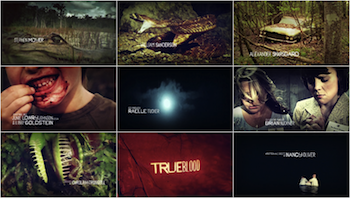
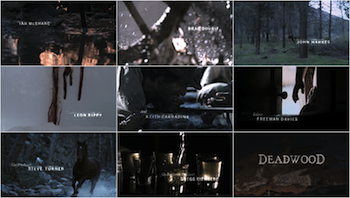
In order to explore this in a little depth I want to look at the affective engagement, abstraction and experimentation in the paratextual space of the opening credits for True Blood [view] and Deadwood [view]. Both of these opening sequences are marked by central ambiguities, as the openings give impressions and tone but relatively little information. This ambiguity is key as the sequences work on an abstract rather than narrational level: neither of these sequences is particularly informative about the series, neither clearly indicates narrative focus, genre or story and neither features a central character. In these sequences, we have no real sense of characters or storylines, yet each is strong in conveying atmosphere, a sense of the historical past and a tonal gothic.
In both Deadwood and True Blood, the emphases are emotional and abstractly conceptual: suggestive of the series and poignant to those familiar with the show, the sequences on their own contain little that is informative or preparatory for the viewer. For example, the opening of True Blood trades in a kind southern gothic through a blending of archival footage of religious ritual, clansmen, animal decay and violence and erotic spectacle. Other than the billboard decrying fangs, there is no indication of the series’ concentration on vampires and the supernatural; instead, natural decay and degradation pair with images suggestive of a strong desire for human interaction, sexual and spiritual. As the producer for True Blood Alan Ball has noted, the opening for the series works toward abstract conceptualism, rather than narrational detail: “I wanted a sense of the twin polarities of the need for transcendence as it plays out in the rural south – of church and sort of whipping yourself up into an evangelical frenzy and the honkytonk on Saturday night where you basically do the same thing only through drugs and hooking up and getting into brawls.” 1
Similarly trading in abstracted and aesthetically beautiful imagery, Deadwood’s opening sequence gives a sense of period and place, but only in very non-specific terms. Fractured images of a butcher, the radiance of blood running down a white screen and a horse running in the wild coalesce to emphasize a vague sense of the dialectic of freedom and restraint, life and death. The brownness of the series’ cinematography is given this privileged moment of quiet respite as the isolated images invite a concentration that the cacophony and muddiness of the actual series does not allow. These effects are intensified in the musical opening that offers the plaintive strains of a fiddle that is tonal and pleasurable, but also indicative of melancholy and loss.
[audio:http://www.davidschwartzmusic.com/music/deadwood.mp3|titles=Deadwood Theme]
Deadwood Theme: Courtesy of David Schwartz Music
I emphasize the auditory aspect, because it is crucial to recognize the place of music in the opening credits. Title songs or themes set tone, mood and play a significant role in both the appeal (or lack of appeal) of the title sequence and the pleasures that can be found in its repeated viewing. Studies on music and cognition have shown that familiarity breeds enjoyment: we are more apt to like a piece of music the more often we hear it, a fact known by mainstream radio, music and culture industries. Together with the experimental, fractured and imagistically oriented visual track of both of these openings, the title music works to mark the opening sequence as a distinct and singular space: David Schwartz’s innovative opening theme “featuring Fiddle, Cavaquinho, Weissenborn, Guitar, Harmonium, Duduk, and Kitchen Pots,” and Jace Everett’s country song “Bad Things” have both taken on lives outside their series-based paratextuality, a status reflected in the opening sequences themselves.
Not merely ancillary, informational, functional, commercially based advertisements for the series, the opening sequence is both an integral part of both Deadwood and True Blood (and many others) and a textually cohesive, if not totally independent, cultural and aesthetic object. Engaging in a contract with the repeat viewer, luring in the neophyte and seducing all, the well designed opening sequence surpasses the boundaries of paratextuality to become a ritualistic event, enacted before every viewing and appreciated as a unique televisual moment, one that becomes more exceptional in its serial repetition.
Image Credits:
1. True Blood title sequence
2. Deadwood title sequence
Please feel free to comment.
This is a fantastic look at the atmospheric montages that have become a staple form of the television title sequence! I love the idea of the sequence as a ritualistic covenant with the viewer, especially when looking at highly serialized shows that eschew episodic formula. Perhaps these shows displace the expectations of the episodic formula–like narrative fulfillment by the end of the hour–onto the ritual of the opening credits.
I find these opening title sequences fascinating. They do SO MUCH in so little time. They present an unusually direct form of communication between the authors of the series and their audience. They explicitly serve to prepare particular viewing postures for the audience. The opening titles present a series of promises about what narrative forms, visual pleasures, formal approaches, and themes to expect. In addition, they offer the most direct expression of the authors’ perception of what is most important about the work. One of my favorite uses is how Twin Peaks used them to almost exclusively set up tone, color and prepare viewers for the oneiric experience to come, although the alienation produced by the removal of the title sequence for the western episode of the The Prisoner is also a favorite.
They get even more fascinating when the creators update them for each season. With Buffy the Vampire Slayer’s, for example, it serves as a tool to position new and returning viewers, to craft a sense of community among their fans, and to communicate the creators’ understanding of their evolving narrative. They document a complex ongoing negotiation.
If you’d like another take on the use of these in a series, I wrote one on Buffy’s use of opening title sequences a few years back.
Thanks for the comments and suggestions!
I have not yet decided, but I thought I might keep with the idea of opening sequences for my next column as well.
Pingback: Using the L Word to talk about title sequences « Feminist Music Geek
In this FLOW TV article, the writer argues that Deadwood’s opening credits shed little to no information at all, in regards to the series’ narrative.
“Both of these opening sequences are marked by central ambiguities, as the openings give impressions and tone but relatively little information. This ambiguity is key as the sequences work on an abstract rather than narrational level: neither of these sequences is particularly informative about the series, neither clearly indicates narrative focus, genre or story and neither features a central character.”
To anyone relatively new to the series, this argument definitely applies. Furthermore, I would agree that the title sequence does precisely what the author states it does: It sets the tone for the historic atmosphere the series is set within.
However, any viewer that has put in the time to watch the series, and give it the close attention it demands may think otherwise. As story lines move forward and characters develop, you can get a real feel for what Deadwood is all about – life in a time of change and turmoil courtesy of westward expansion.
As for the opening titles itself, it’s largely a cross between a horse running through the western frontier and images representative of human civilization. Because Deadwood is about the dying days of the old west, to me, the arrangement of the opening credits is anything but a coincidence. We see a horse running through the impressive wilderness of the west and then we see things such as butchering butchers, carriages being driven, and whiskey shots being poured. These human images each represent different aspects of civilization.
Butchers – Business and food services
Carriages – Transportation
Whiskey – Product consumption and social life
Gold – Capitalism and economics – in this case, literally arising from the ground and beneath the surface
The very end of the opening sequence provides the most telling image of all. A puddle of splashing water settles to reveal the horse standing tall in Deadwood’s thoroughfare with the Gem Saloon towering above it in the background. While the authors of the FLOW TV article may believe the opening sequence doesn’t tell much of a story at all, I think it tells two stories and sets the stage for a third one to be played out in the show. One story is the story of the wild west and its vast frontiers. The second, is a vague historical retelling of what America’s western movement looked like. The third and final story is what took place when the first two stories collided. And that story, is Deadwood.
Good points and a nice reading of the opening. I agree with you completely — to clarify though, in this article I was not suggesting that the credits do not have meaning, but that they do not offer up a clear cause and effect linear narration of events or a character-centric denotation indicating a clear focalizer for the narration who is apparent from the very beginning. What I meant was that the credits proceed along different modes of meaning making that stress more abstract associations, tonal dominants, graphic matches and parallel structures. And I think your analysis supports the ways in which these different modes make strong connections and evocative associations, especially as the show progresses. The credits for Deadwood work in especially interesting ways to draw the audience in repeatedly as the show progresses and we begin to recognize and contextualize some of these opening images in richer and more complex ways.
Thank you for this insightful, engaging article. The lack of scholarly discussion about television introductory sequences has been a surprise to me as well, especially as their production has grown into such a lucrative industry and their premiers have become highly awaited events in the media-development community. Popularity aside, there is also successful artistry and provoking thought embedded in these openings that span a variety of genres and networks; I would imagine this to be quite a rich site for interpretation. Furthermore, since these sequences are, as you discuss, paratextual elements – setting the scene and the tone for the show without, in fact, dispensing any narrative information – it would seem that they have a great deal of material to unpack, their subtext and interaction with the program’s main text for starters.
As you have discussed the use and meaning of two introductions that “give impressions and tone but relatively little information,” I would like to address an opening that succeeds in presenting both the tenor of the show and insight into its story, and still acts as a paratextual element. The preamble sequence of Game of Thrones serves as an index, separate from each episode’s narrative arc but contextualizing and presenting the overall schema nonetheless. The flyover viewpoint of the opening situates the viewer within the program’s fictional world of Westeros, as the camera navigates a CGI map of the seemingly never-ending country, pausing to zoom in on various locations. Every opening has the potential to be different, showcasing a new place or eliminating a previous setting, indicating which locales will be visited in the episode it precedes, In this way, the introduction functions as would a map section in a book’s appendix: it details each step of each character’s journey as he or she takes it. (Interestingly, the sequence was designed after the maps in George R.R. Martin’s hardcopy editions of the A Song of Ice and Fire books on which the series is based.) Meanwhile, the booming score of the introduction, hinting at a Celtic sound, introduces the medieval setting and its epic scope, while the excellent CGI signals the high production values – and the cinematic quality, if you will – of the program to follow.
The fact that Game of Thrones hails from HBO – as True Blood and Deadwood do – does not appear to me to be a coincidence. Rather, I see it as an illustration of HBO’s overall business strategy. The network has ostensibly been at the forefront of major changes in television’s structure and the emergence of new trends in media for quite a while. Even before it jumpstarted the “quality programming” bandwagon, HBO had demonstrated great success in promoting itself as elite, and was, accordingly, the first network to garner dramatically high profits from this image. The case of preamble sequences is no different: the network anticipated a trend (or, at least, caught it early) and put extensive resources toward making its product the best and itself the frontrunner. Though there have certainly been great opening sequences throughout television history, the financial clout and creative resources available to HBO have made it difficult for other networks to compete. Even the patriotic swell that accompanies the opening bars of The West Wing doesn’t quite match up to the intellectual panache of cigar-smoking Tony Soprano driving down the New Jersey Turnpike.
When reading through the list of articles, I clicked on this one in particular because I thought that the concept of televisual title is one that True Blood does very well. Because of this, I was not surprised to see that True Blood was in fact one of the examples used on the article alongside other HBO shows such as Dead Wood. Lisa Coulthard starts her article by saying “Opening sequences seduce, prepare and inform the audiences.” As a person who started watching the show because of the opening sequence and as someone which became a loyal member of the True Blood cult, I can say that True Bloods opening sequence seduces, prepare and inform the audience of what is about to happen.
The opening credits consist of a montage of images of animals and humans decomposing, religious symbolism and racial discrimination and are accompanied by the lyrics “I wanna do bad things to you”. They do not directly reference any of the characters or storyline, which makes them a sort of separate piece of art. However, they incite in the viewer a sort of excitement and visual hunger for what is about to come.
Digital Kitchen is the company responsible for making the opening credits. In a case studio about the making of the title sequence they say that they wanted to show the point of view of a supernatural predatorial being. By placing the viewer in such a position at the beginning of the show, they are inviting us to a world, which seems kind of awesome and mysterious but yet quite grotesque. If you had initially thought that a show about vampires was kind of stupid, the opening credits for True Blood leave behind all the fantastical and fairy like conventions which have accompanied vampires for the past few years. It says, we are serious, we are a show about grotesque pure evil and animalistic instincts but don’t deny you wouldn’t want to be a part of it if you could.
Furthermore, Coulthard also argues that “Engaging in a contract with the repeat viewer, luring in the neophyte and seducing all, the well designed opening sequence surpasses the boundaries of paratextuality to become a ritualistic event, enacted before every viewing and appreciated as a unique televisual moment, one that become more exceptional in its serial repetition.” Every episode of True Blood starts off exactly were the last finished, cultivating a sort of excitement even before the show starts. In the middle of the scene however, it cuts to the opening credits. Because they are not necessary to watch in order to understand the story, you could fast forward or get up and do something else. However, there is a sort of pleasure in watching the opening credits episode after episode. I would never dare fast-forward through the opening credits; they are my favorite part of the show. They provide a sense of familiarity, which remind you, about what is about to come and why you love the show so much. Even the lyrics continue replaying in your head all through the episode and long after.